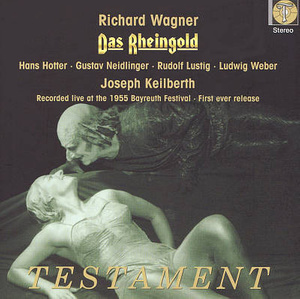
Wagner: Das Rheingold (瓦格纳:莱茵的黄金)
Joseph Keilberth专辑介绍:The first stereo Ring CycleRichard WagnerDER RING DES NIBELUNGENA Stage Festival for 3 Days and a Preliminary Evening/Ein Bühnenfestspiel für 3 Tage und einen Vorabend/Un Festival scénique pour 3 jours et une soiréePrologue/VorabendDAS RHEINGOLDWotan - Hans HotterFricka - Georgine von MilinkovicLoge - Rudolf LustigAlberich - Gustav NeidlingerMime - Paul KuenDonner - Toni BlankenheimFroh - Josef TraxelFreia - Hertha WilfertErda - Maria von IlosvayFasolt - Ludwig WeberFafner - Josef GreindlWoglinde - Jutta VulpiusWellgunde - Elisabeth SchärtelFloßhilde - Maria GrafOrchester der Bayreuther Festspieleconducted by/Dirigent/direction: Joseph KeilberthRecorded/Aufgenommen/Enregistré: Festspielhaus Bayreuth, Sunday/Sonntag/dimanche 24 July/Juli/juillet 1955by James LeonardA perfectly acceptable performance, Joseph Keilberth's Das Rheingold at the 1955 Bayreuth Festival would no doubt have satisfied most listeners. But although the performance was taped in stereo by Decca, the recording remained unreleased until 2006 when Testament finally issued it, and by that time finer performances, including Decca's own Rheingold with Georg Solti, had appeared and rendered Keilberth's more or less superfluous. It's not that there aren't great things here. The men are first rate, especially the magisterial Hans Hotter as Wotan, the malevolent Gustav Neidlinger as Alberich, and whiney Paul Kuen as Mime. Even the giants, Ludwig Weber as Fasolt and particularly Josef Greindl as Fafner are splendid. The women are less appealing: Georgine von Milinkovic as Fricka is too harsh and shrewish, while the Rheinmaidens are too cute and girlish. But Keilberth himself is the biggest disappointment. A more than competent conductor, Keilberth moves the music forward with confidence and supports the singers with sensitivity, but rarely does he elicit more than adequate playing from the Bayreuth Festival Orchestra and never does he make the orchestra a full partner in the drama. For listeners who are already deeply familiar with the contemporary Rheingolds of Furtwängler, Knappertsbusch, and Krauss, Keilberth's will be an interesting addition. But for listeners not already familiar with those greater Rheingolds or with the later Rheingolds of Solti, Karajan, Haitink, Sawallisch, and Levine, Keilberth's will not be particularly interesting, much less necessary. The first stereo recording of the work, this Rheingold has amazingly clean and evocative live sound for its time.
